Embracing the circular economy: Redefining waste, reclaiming value.
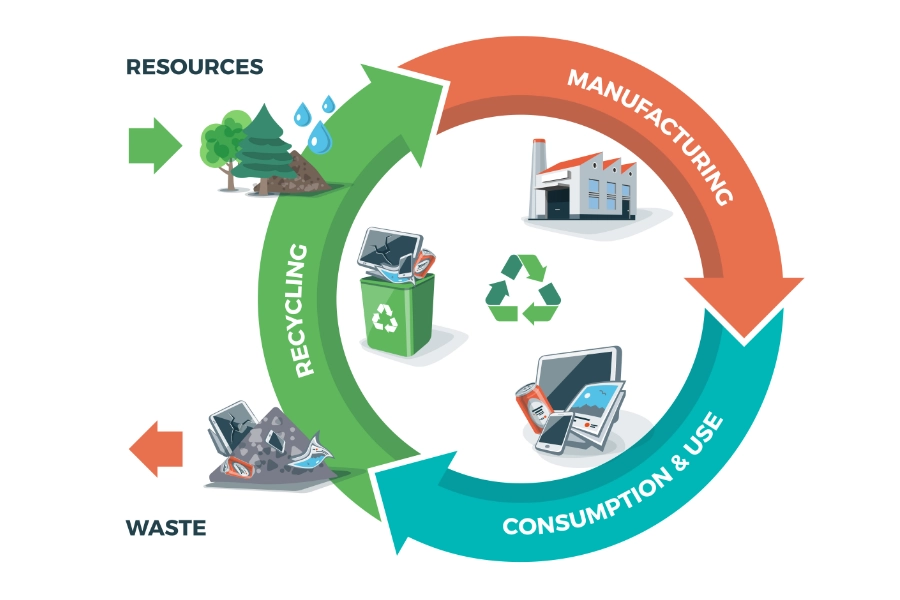
In an age of overconsumption, the circular economy offers a smarter way forward. While recycling organic waste is becoming standard practice, tackling non-organic waste reveals a more complex challenge – and a major opportunity for innovation, savings and sustainability.
What is the circular economy?
At its core, circular economic theory is built on a bold but simple idea: materials aren’t waste – they’re resources. Instead of the traditional linear path (take, make, dispose), a circular system closes the loop, keeping materials in use for as long as possible.
Imagine a world where products are designed for durability, systems prioritise reuse, and waste becomes a thing of the past. That’s the circular future.
Two paths, one purpose: Organic vs non-organic waste
Every product we consume follows one of two journeys – organic or non-organic – and circularity transforms how each is handled at end-of-life.
Organic materials: Nature’s own loop
Organic waste, such as food scraps, garden clippings or untreated fabrics, follows a relatively simple, cost-effective recovery process:
- Composting
- Anaerobic digestion or energy conversion
- Biochemical feedstocks
These methods are efficient, quick to implement, and environmentally positive. That’s a win-win.
Non-organic materials: Smart systems for complex products
Non-organics – especially composite items like electronics or household appliances – require more sophisticated recovery loops:
- Repair: Extend product life with minimal cost and effort
- Reuse and redistribution: If you no longer need it, someone else might
- Remanufacturing : Common in industrial settings (like engines), where used items are restored to like-new condition
- Recycling: Materials are broken down and reprocessed, not as virgin materials, but as valuable inputs into new products
Shorter loops mean greater efficiency. For example, repairing a washing machine is far less resource-intensive than recycling it or replacing it altogether.
The butterfly effect: A circular blueprint
One of the most powerful visual models of this approach is the Butterfly Diagram, developed by the Ellen MacArthur Foundation in collaboration with Delft University. It illustrates how both organic (green loops) and non-organic (blue loops) materials can flow back into the system rather than ending up as waste.
Each loop represents an opportunity: to recover value, save energy, reduce emissions and build a regenerative economy.

At the top of the diagram are raw materials such as metals, plastics, fruits and vegetables. These go through various processes (like manufacturing or food preparation) and end up with consumers, shown as large circles further down the diagram.
The diagram is split into organic materials on the left (green) and non-organic materials on the right (blue).
The key point is what happens after these materials are used. In a linear economy, everything goes straight to landfill. But the circular economy sees used materials as valuable and aims to keep them in use – not waste.
- Organic waste (like food) can be composted, used for energy, or turned into biochemicals. This is relatively simple and cost-effective.
- Non-organic materials (like electronics) are more complex and follow several steps or “loops”:
- Repair: Fix broken items instead of throwing them out
- Reuse or redistribute: Pass items on to others who can use them
- Remanufacture: In industry, items like truck engines can be rebuilt and sold again
- Recycle: Materials are broken down and reused in new products. This is the most resource-intensive loop
The general rule is: the shorter the loop, the better. Fixing an appliance, for example, is cheaper and uses fewer resources than recycling it.
While circular economy practices are well underway in Europe, South Africa is just getting started. Awareness is growing, especially among businesses, and some are already taking steps to adopt these principles. Starting sooner makes the shift away from the linear model easier and less costly in the long run.
Why South Africa can’t wait
The circular economy is gaining traction globally, especially in Europe where regulations and industry action are driving meaningful change. And here at home?
South Africa is ready – but we can’t afford to wait.
Businesses are beginning to feel the pressure from stakeholders, consumers and regulators. Many are reaching out to partners like us for practical guidance and support. The shift won’t be instant, but the earlier we act, the easier the transition will be.
How we can help?
At Waste Synergy, we work with companies ready to future-proof their operations through circular thinking. From waste audits to strategy design, we guide you every step of the way – ensuring progress is measurable, practical and aligned with your goals.
Let’s build a future where nothing goes to waste. Start your circular journey today.
Talk to Waste Synergy and discover how sustainability becomes a strategic advantage.